

主题:四个反身代词短语(by/for/to/of oneself)语义辨析及应用
核心目标:掌握“独自、为自己、独用、自动”的本质差异,精准匹配语境
第一部分:核心区别总览
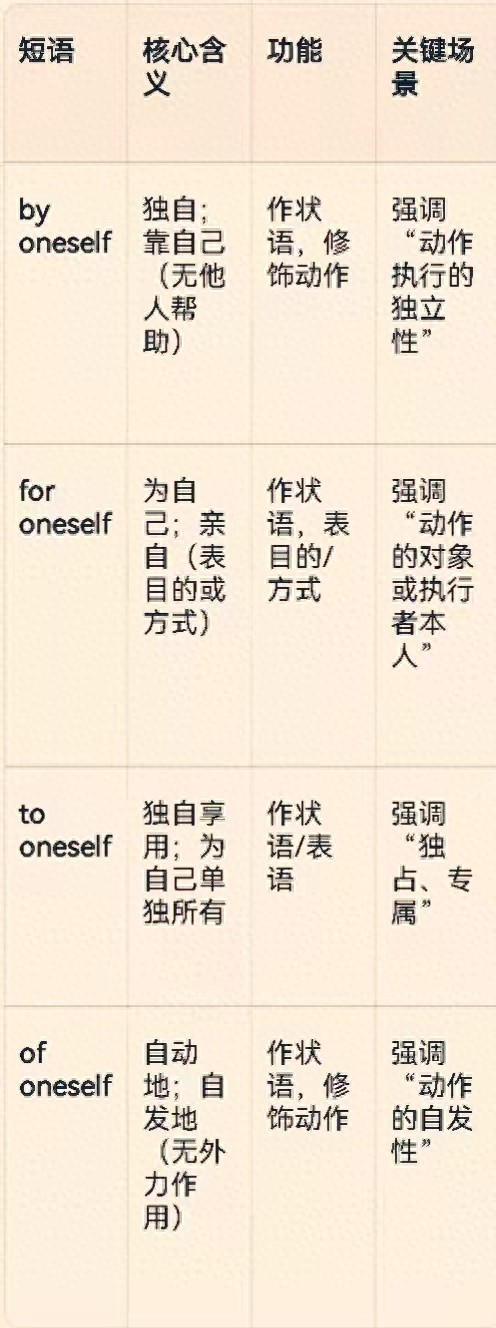
第二部分:详细用法与例句解析
1. by oneself(独自;靠自己)
用法:强调“动作由主语独立完成,无他人协助或陪伴”,可替换为“alone”或“without help”。
例句1:一般过去时,含结果状语从句
句子:He finished the difficult project by himself, which surprised all his colleagues.
结构解析:
[主语He] + [一般过去时finished] + [宾语the difficult project] + [状语by himself] + [非限制性定语从句which surprised all his colleagues]
标记:He finished the difficult project by himself, which surprised all his colleagues.
说明:“by himself”表“他独自完成项目”,强调无他人帮助,修饰动词“finished”,体现动作独立性。
例句2:一般将来时,含条件状语从句
句子:If you don’t ask for help, you will have to solve this problem by yourself.
结构解析:
[条件状语从句If you don’t ask for help] + [主句主语you] + [一般将来时will have to solve] + [宾语this problem] + [状语by yourself]
标记:If you don’t ask for help, you will have to solve this problem by yourself.
说明:“by yourself”表“你得靠自己解决问题”,强调“无外力协助”,修饰动词短语“have to solve”。
2. for oneself(为自己;亲自)
用法:表“动作是为了主语本人”或“主语亲自做某事”,突出“目的或亲自参与”。
例句1:一般现在时,含原因状语从句
句子:She always cooks meals for herself because she thinks takeout is unhealthy.
结构解析:
[主语She] + [一般现在时cooks] + [宾语meals] + [状语for herself] + [原因状语从句because she thinks takeout is unhealthy]
标记:She always cooks meals for herself because she thinks takeout is unhealthy.
说明:“for herself”表“为自己做饭”,强调目的是“主语本人”,修饰动词“cooks”。
例句2:现在完成时,含宾语从句
句子:I have never bought expensive gifts for others, only for myself, which my friends don’t understand.
结构解析:
[主语I] + [现在完成时have never bought] + [宾语expensive gifts] + [状语for others] + [状语only for myself] + [非限制性定语从句which my friends don’t understand]
标记:I have never bought expensive gifts for others, only for myself, which my friends don’t understand.
说明:“for myself”表“只为自己买礼物”,强调“对象是本人”,补充说明动作“bought”的范围。
3. to oneself(独自享用;独用)
用法:表“某物/空间为某人单独所有或使用”,常与“keep, have, take”等动词搭配。
例句1:一般现在时,含定语从句
句子:The old man keeps the small garden to himself because he likes quiet.
结构解析:
[主语The old man] + [一般现在时keeps] + [宾语the small garden] + [状语to himself] + [原因状语从句because he likes quiet]
标记:The old man keeps the small garden to himself because he likes quiet.
说明:“to himself”表“花园由老人独自使用”,强调“独占”,修饰动词“keeps”。
例句2:一般过去时,含时间状语从句
句子:When she lived alone, she took the big bedroom to herself.
结构解析:
[时间状语从句When she lived alone] + [主句主语she] + [一般过去时took] + [宾语the big bedroom] + [状语to herself]
标记:When she lived alone, she took the big bedroom to herself.
说明:“to herself”表“她独占大卧室”,强调“专属”,修饰动词“took”。
4. of oneself(自动地;自发地)
用法:表“动作无需外力推动,自然发生”,主语多为事物,少用于人。
例句1:一般现在时,含让步状语从句
句子:Even if no one touches it, the door opens of itself because it’s broken.
结构解析:
[让步状语从句Even if no one touches it] + [主句主语the door] + [一般现在时opens] + [状语of itself] + [原因状语从句because it’s broken]
标记:Even if no one touches it, the door opens of itself because it’s broken.
说明:“of itself”表“门自动打开”,强调“无外力,自发发生”,修饰动词“opens”。
例句2:一般过去时,含宾语从句
句子:The light went out of itself, which made us think there was a power cut.
结构解析:
[主语The light] + [一般过去时went out] + [状语of itself] + [非限制性定语从句which made us think there was a power cut]
标记:The light went out of itself, which made us think there was a power cut.
说明:“of itself”表“灯自己灭了”,强调“无外力作用”,修饰动词短语“went out”。
第三部分:实战练习题
题目:用“by/for/to/of oneself”填空,并说明理由。
1. The little girl learned to tie her shoes ____________ without her mother’s help.(小女孩没靠妈妈帮忙,自己学会了系鞋带。)
2. He made a birthday card ____________ because he wanted to show his true feelings.(他亲自做了一张生日贺卡,因为想表达真实的情感。)
3. The writer keeps that special pen ____________ and never lets others use it.(这位作家把那支特别的笔独自留着,从不让别人用。)
4. The window closed ____________ when the wind blew strongly.(风刮大时,窗户自己关上了。)
答案与解析
1. 答案:by herself
理由:强调“无他人帮助,独自学会”,体现动作独立性,修饰动词“learned”,用“by oneself”。
2. 答案:for himself
理由:强调“亲自做贺卡”,表动作由本人执行,目的是表达情感,修饰动词“made”,用“for oneself”。
3. 答案:to himself
理由:强调“笔由作家独占,不让他人使用”,体现“专属”,修饰动词“keeps”,用“to oneself”。
4. 答案:of itself
理由:强调“窗户无外力推动,因风吹自动关上”,体现动作自发性,修饰动词“closed”,用“of oneself”。
总结:
记忆口诀:by独做(靠自己),for为己(亲自做),to独占(归自己),of自动(不用推)。
关键判断:先明确语境是“独立做、为自己、独占、自动”,再匹配对应短语,主语为人/物可辅助区分(of oneself多接事物)。