
、试题题目
假定你是校英文报记者,在2025年结束之际,你们学校的英语俱乐部举办了名为“Word of the Year 2025”校园年度英语词汇的征集和评选活动,请你为此写一篇报道。内容包括:
1.活动内容;
2. 活动意义。
二、英文范文
Last week, the English Club in our school organized an engaging “Word of the Year 2025” collection and selection activity, which attracted widespread participation from students.
The activity unfolded in a well-structured way. Initially, students gathered for in-depth discussions in each class, where they explored campus life and personal growth, and shared their thoughts. What’s more, students were required to submit their words accompanied by explanations of why they believed these words were appropriate. After that, all the nominated words were presented on the school’s website for a school-wide vote. Eventually, “youth” stood out due to its resonance (共鸣) with the strength and potential of the school.
This activity not only stimulates students’ enthusiasm for English learning but also encourages them to think deeply about their experiences and the world around them. As the selected word, “youth” serves as a reminder of the preciousness of our youthful days.
三、作文分析(审题思路)
(一)审题思路:段落内容规划逻辑
拿到该报道类应用文题目后,核心审题方向是“明确身份、紧扣要求、梳理逻辑”,具体段落内容规划可按以下步骤思考:
1.第一步:确定文章体裁与身份定位——题目明确要求写“报道”,且身份是“校英文报记者”,因此文章需保持客观、简洁的报道风格,语言正式但不晦涩,同时要贴合校园场景,让读者(师生)清晰了解活动全貌。
2.第二步:拆分核心写作要求,对应段落布局——题目明确要求包含“活动内容”和“活动意义”,结合报道的常规结构,建议采用“三段式”布局:
① 首段(总起段):快速交代核心要素——活动主办方(学校英语俱乐部)、活动名称(“Word of the Year 2025”)、活动基本效果(吸引广泛参与),让读者快速抓住活动核心信息,避免冗余。
② 第二段(核心段:活动内容):按时间顺序梳理活动流程,这是“活动内容”的核心。需明确活动的关键环节(讨论→提交词汇→展示投票→选出结果),用衔接词串联,确保流程清晰可追溯,避免环节混乱。
③ 第三段(升华段:活动意义):从活动对学生的实际影响出发,提炼两层意义——一是语言学习层面(激发英语学习热情),二是思想成长层面(引导深入思考);同时结合当选词汇“youth”的内涵,让意义更具体,避免空洞喊口号。
第三步:筛选适配语言风格——报道需简洁准确,可选用“organized、engaging、unfolded”等正式且贴合校园场景的词汇;时间衔接词(Initially、After that、Eventually)必不可少,确保段落内部、段落之间逻辑连贯。
四、重点语言点通俗解析
1. engaging(形容词)
•原文语境:Last week, the English Club in our school organized anengaging “Word of the Year 2025” collection and selection activity...
•核心含义:有趣的、吸引人的,比常用的“interesting”更高级,能体现活动让人愿意参与的特点
•用法:修饰活动、故事等,放在名词前作定语
•例句:The teacher told an engaging story in class.老师在课堂上讲了一个有趣的故事。
2. collection and selection名词短语
•原文语境:...organized an engaging “Word of the Year 2025” collection and selection activity
•核心含义:征集与评选,“collection”是“收集、征集”,“selection”是“挑选、评选”,体现“先收后选”的流程
•用法:常和“activity”搭配(collection and selection activity),作动词“organize/hold”的宾语
•拓展例句:We need to plan a painting collection and selection.我们需要策划一场绘画征集与评选。
3. attract widespread participation from students动词短语
•原文语境:...whichattracted widespread participation from students.
•核心含义:吸引学生广泛参与
•用法:主语多为活动、事件,“from students”明确参与对象,可替换为“from teachers”等
•例句:The sports meeting attracted widespread participation from students.运动会吸引了学生的广泛参与。
4. The activity unfolded in a well-structured way.(完整句子)
•原文语境:The activity unfolded in a well-structured way.
•核心含义:描述活动开展得流程清晰、有条理
•拆解讲解:① unfold(动词):开展、进行;② in a well-structured way(介词短语):以流程清晰的方式
•仿写例句:The party unfolded in a well-structured way.这场派对开展得有条有理。
5. initially adv.
•原文语境:Initially, students gathered for in-depth discussions in each class...
•核心含义:起初、最初,表时间顺序的衔接词
•用法:放句首,后加逗号,常和after that、eventually搭配
•例句:Initially, we didn't know how to start the group project, but our teacher gave us useful advice.起初,我们不知道如何开始小组项目,但老师给了我们实用的建议。
6. gather for in-depth discussions(动词短语)
•原文语境:students gathered for in-depth discussions in each class(学生们以班级为单位聚集起来开展深入讨论)
•核心含义:聚集起来进行深入讨论,“gather”是“聚集”,“in-depth discussions”是“深入讨论”
•用法:主语是人,“for”表目的,说明聚集的目的是讨论
7. share their thoughts(动词短语)
•原文语境:...and shared their thoughts(……并分享了他们的想法)
•核心含义:分享想法、观点,“thoughts”此处指“看法”,不是“思考”
•用法:share one's thoughts(分享某人的想法),可加with sb(和某人分享)
•例句:She shared her thoughts with the class.她和全班分享了她的想法。
8. submit(动词)
•原文语境:students were required to submit their words...(学生们被要求提交他们的词汇……)
•核心含义:提交、上交(作业、材料、表格等),校园/工作常用词
•用法:submit sth(提交某物),常和to搭配(submit sth to sb 提交给某人)
•例句:We need to submit our homework to the teacher.我们要把作业交给老师。
9. words accompanied by explanations of why they believed these words were appropriate(名词短语)
•原文语境:submit their words accompanied by explanations of why they believed these words were appropriate(提交所选词汇,并说明为何认为这些词汇合适)
•核心含义:附有适配理由说明的词汇,“accompanied by”是“附有、伴有”,“appropriate”是“合适的”
•拆解理解:words(词汇)+ accompanied by explanations(附有说明)+ of why...appropriate(说明为什么合适)
10. nominated(形容词/动词过去分词)
•原文语境:all the nominated (提名的) words(所有提名词汇)
•核心含义:被提名的、被推荐的,由动词“nominate(提名、推荐)”变形而来
•用法:作定语修饰名词(如words、people、works等)
•例句:The nominated students will give speeches.被提名的学生将进行演讲。
11. be presented(动词短语,被动语态)
•原文语境:all the nominated words were presented on the school’s website(所有提名词汇被展示在学校官网上)
•核心含义:被展示、被呈现,“present”此处是“展示、陈列”的意思
•用法:被动语态(be + presented),常接地点状语(on the website、in the classroom等)
•例句:The students' works were presented in the hall.学生们的作品被展示在大厅里。
12. a school-wide vote(名词短语)
•原文语境:for a school-wide vote(供全校投票)
•核心含义:全校范围的投票,“school-wide”是“全校范围的”,“vote”是“投票”
•用法:常作介词for的宾语,表目的;“school-wide”可替换为“class-wide(全班范围的)”等
•例句:We will have a school-wide vote for the new logo.我们将为新校徽进行全校投票。
13. eventually adv.
•原文语境:Eventually, “youth” stood out...(最终,“青春”一词脱颖而出……)
•核心含义:最终、最后,表时间顺序的收尾衔接词
•可替换Finally、At last(更基础常用)
14. stand out(动词短语)
•原文语境:“youth” stood out due to its resonance...(“青春”一词因……而脱颖而出)
•核心含义:脱颖而出、显得突出,指在众多事物中更优秀、更显眼
•用法:主语可为人或事物,常接due to(因……)说明原因
•例句:She stood out in the singing competition.(她在歌唱比赛中脱颖而出。)
•替换词:be outstanding(形容词短语,如:He is outstanding in math.)
15. resonance/ˈrezənəns/ with(名词短语)
•原文语境:its resonance (共鸣) with the strength and potential of the school(它与校园的活力和潜力产生的共鸣)
•核心含义:与……的共鸣,“resonance”是“共鸣”,“with”连接共鸣的对象
•用法:常用搭配“resonance with sth/sb(与某物/某人的共鸣)”
•例句:The song has a strong resonance with young people.这首歌引起了年轻人的强烈共鸣。
16. stimulates vt.
•原文语境:This activity not only stimulates students’ enthusiasm for English learning...(这项活动不仅激发了学生学习英语的热情……)
•核心含义:激发、调动(热情、兴趣等),比“encourage”更精准
•用法:stimulate sth(激发某物),常用搭配“stimulate sb's enthusiasm for sth(激发某人对某事的热情)”
•例句:The interesting game stimulates students' interest in science.这个有趣的游戏激发了学生对科学的兴趣。
•替换词:arouse(更易理解,如:arouse interest in reading 激发阅读兴趣)
17. enthusiasm(名词)
•原文语境:...stimulates students’ enthusiasm for English learning(……激发学生学习英语的热情)
•核心含义:热情、热忱,指对某事积极投入的情绪
•用法:常用搭配“enthusiasm for sth(对某事的热情)”
•例句:He has great enthusiasm for sports.他对体育有极大的热情。
18. serve as a reminder of(动词短语)
•原文语境:“youth” serves as a reminder of the preciousness of our youthful days(“青春”提醒着我们青春岁月的珍贵)
•核心含义:作为……的提醒、提醒某人……,比简单的“remind sb of”更正式
•用法:主语通常是具体事物(word、photo、gift等),后接“需要提醒的内容”
•例句:The old photo serves as a reminder of my childhood.这张旧照片提醒着我我的童年。
•替换词:remind us of(如:“youth” reminds us of the precious youthful days)
19. preciousness n.
•原文语境:the preciousness of our youthful days(我们青春岁月的珍贵)
•核心含义:珍贵、宝贵,由形容词“precious(珍贵的)”变形而来
•用法:常作名词短语的中心词,常用搭配“the preciousness of sth(某物的珍贵)”
•例句:We should understand the preciousness of time.我们应该明白时间的珍贵。
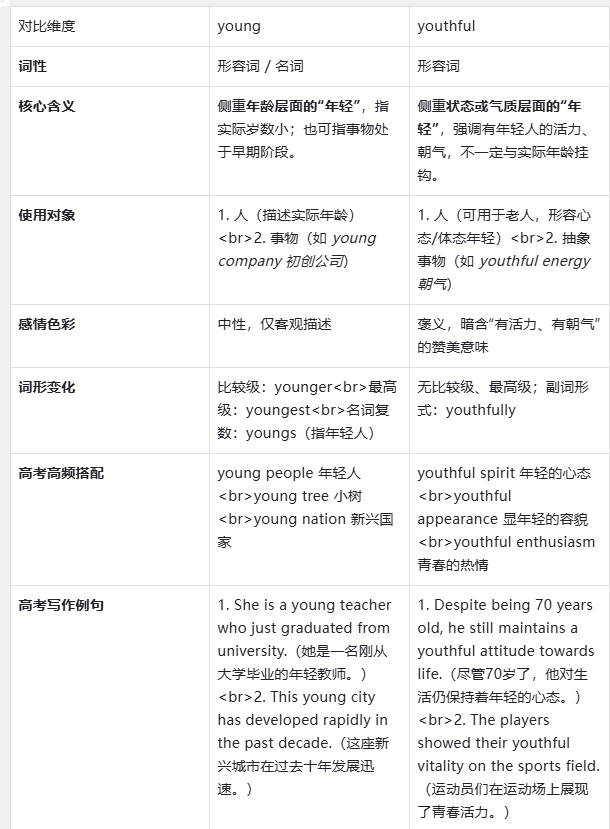
20. youthful adj.
•原文语境:the preciousness of our youthful days(我们青春的岁月的珍贵)
•核心含义:青春的、年轻的,用来形容和“青春”相关的事物
•用法:作定语修饰名词(days、energy、spirit等)
•例句:She has a youthful spirit.她有着青春的活力。
•替换词:young(年轻的,更简单,如:our young days 我们的年轻岁月)
二者对比辨析: